projects
communication infrastructure and state visualization
Julia-Robin Schuster
Janek Engel
Hong Lâm Nguyen
Finja Adam
An overview of the communication protocol stack, server-side business logic, and visualization architecture developed by the interface group for the MAMAgotchi tangible interaction project.
This article documents the contribution of the interface group to the MAMAgotchi tangible interaction project. While the accompanying station groups were responsible for the physical hardware placed throughout the different rooms, our group designed and implemented the underlying communication infrastructure and the server-side business logic that translates physical interactions into the behavior of a virtual companion. In addition, we were responsible for the technical implementation and integration of the visualization, the conceptual design of which was developed by a separate group within the project. This post describes the architectural decisions made, the protocols evaluated, and the technical realization of the visualization components as well as the business logic of the MAMAgotchi.
Project Context
MAMAgotchi is a distributed tangible interaction system in which physical stations located in different rooms (the bedroom, kitchen, dance room, and playroom) register the completion of everyday tasks and translate them into a shared score. This score determines the mood and appearance of a virtual pet, the MAMAgotchi, displayed on a central screen. The individual station hardware and interaction concepts are described in the respective station groups’ contributions; this article focuses exclusively on the infrastructure connecting these stations to a coherent, centrally maintained system.
System Architecture
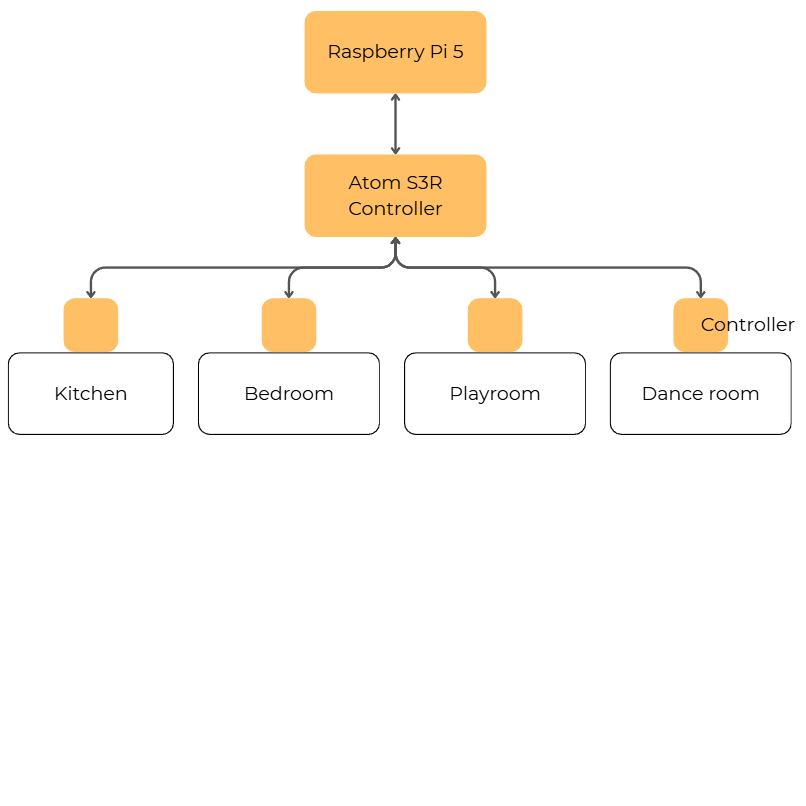
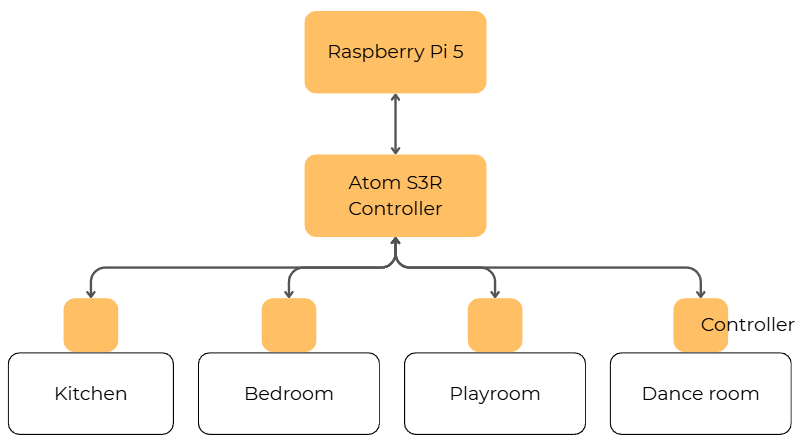
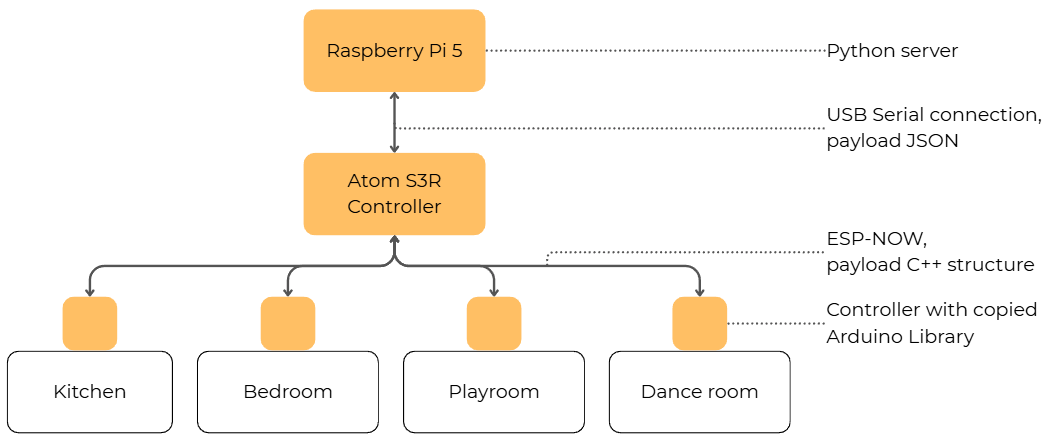
The system is organized into three tiers: distributed stations, a central M5Stack AtomS3R controller (M5Stack, 2026), and a Raspberry Pi 5 (Raspberry Pi Foundation, 2026) as shown in Figure 1. Stations communicate wirelessly with the controller, which in turn forwards all data to the Raspberry Pi over a wired connection. The Raspberry Pi hosts both the business logic that maintains the MAMAgotchi’s state and the visualization presented to the user.
Station-to-Controller Communication: ESP-NOW
Communication between individual stations and the AtomS3R controller is implemented using ESP-NOW, a connectionless, low-latency wireless protocol designed for ESP32-based microcontrollers (Espressif Systems, 2026). ESP-NOW was selected primarily because the station hardware was built on the M5Stack platform, for which ESP-NOW is natively supported as a connectionless communication protocol. This made it the most direct and low-effort choice for wireless communication between stations and the controller, without requiring an additional network stack or infrastructure such as a WiFi access point.
To reduce the integration effort for the station groups, we developed a dedicated Arduino library(see library repository) that abstracts the ESP-NOW protocol and is distributed together with example code and accompanying documentation. This allowed station groups to integrate their hardware without requiring in-depth knowledge of the underlying wireless communication stack (see Figure 1).
Station identification is handled automatically: upon transmitting its first message, a station’s MAC address is registered by the controller, eliminating the need for manual configuration of station identities. All payloads are transmitted using a shared C++ structure, tangible_dto, comprising the following fields:
- Score (integer) — accumulated points recorded at the station
- Blocked (boolean) — current lock state of the station
- Station (enum) — station identifier
- MacAddress (uint8_t[6]) — hardware address of the originating station
Controller-to-Server Communication: USB Serial
Establishing reliable communication between the AtomS3R controller and the Raspberry Pi server required more extensive evaluation than initially anticipated. Two alternative approaches were prototyped and subsequently discarded: a UDP-based server architecture, and a Python reimplementation of the ESP-NOW protocol (ChuckMash, 2026). Both approaches introduced either excessive implementation complexity or insufficient reliability for the scope of this project.
The final architecture instead relies on USB serial communication, transmitting a compressed JSON string between controller and server. Although the serial interface of ESP32-based controllers is conventionally reserved for debugging output, repurposing it for application-level communication proved to be the more robust and maintainable solution. Communication in both directions is event-driven: updates are transmitted only when the underlying state changes, minimizing communication overhead and latency. For the two-sided communication, USB serial communication was a reliable and stable choice.
The result of the various communication protocols and the data sent over the connections is the system architecture (see Figure 2). All communication steps were tested with the individual station groups.
Server-Side Architecture
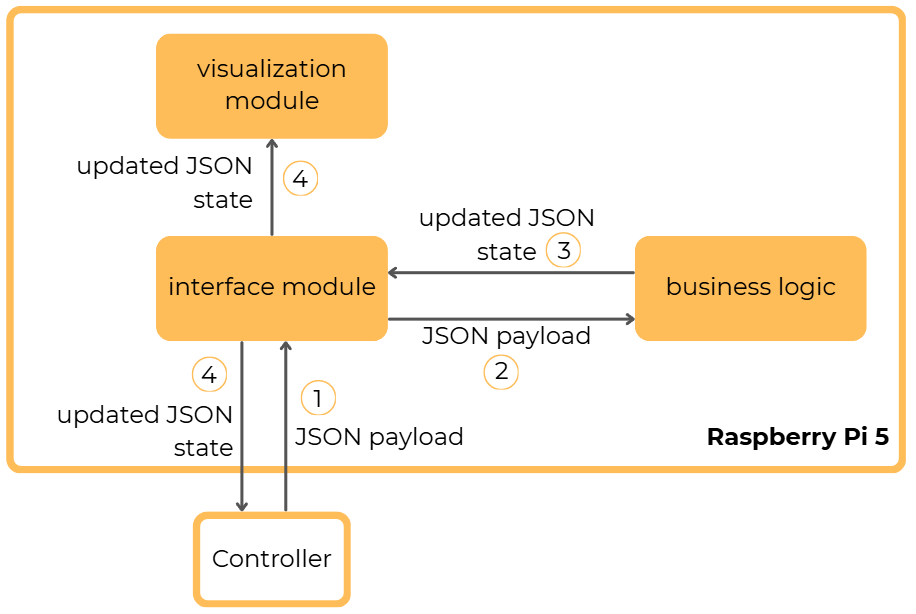
The Raspberry Pi is structured into three cooperating modules:
- Interface module
Receives and parses incoming JSON messages relayed from the stations via the controller and sends it to the business logic module (see step 1 and 2 in Figure 3). Receives state changes from the business logic module and sends it back to the controller and the visualization (see step 3 and 4 in Figure 3). Written in Python. - Business logic module
Maintains the authoritative state of the MAMAgotchi and reconstructs its JSON representation whenever new station data is received (e.g., following the completion of a task at a station) or the state is updated over time. Sends the updated states to the interface module (see step 3 in Figure 3). Written in Python. - Visualization module
A JavaScript-based front end that consumes the state produced by the business logic module and renders it accordingly (see step 4 upward arrow in Figure 3). Our contribution consisted of implementing and integrating the given design into a functioning front end driven by the live system state.
Communication between the business logic and visualization modules is unidirectional and provided via a local web server, from which the JavaScript-implementation of the visualization periodically fetches the current state (see Raspberry Pi repository).
Business-Logic: Need-Based State Model
The business logic module is centered around a small set of needs: movement, energy, satiety, and play. Each of which is influenced by the four rooms of the apartment. Completing a task in a room increases its associated needs, while needs decay over time if left unattended. The aggregate of all needs determines the MAMAgotchi’s overall mood, which is classified into three states: content (aggregate score above 66%), neutral, and discontented (aggregate score below 33%). The states are mapped to a corresponding visual representation. In addition to this continuous mood state, individual needs can trigger a blocking mechanism: if a specific need falls below a critical threshold (e.g., 15%), the rooms associated with replenishing other needs are temporarily locked until the critical need is addressed. For instance, a critically low satiety value blocks the use of the sleep, dance, and play stations until the kitchen station has been used. This mechanism was designed to reflect the project’s underlying metaphor of care work and is implemented as a finite-state model driving both the blocking logic and the corresponding visual feedback.
Deployment and Autostart
To simplify deployment, the Raspberry Pi is configured to start the entire system automatically without manual intervention. Once connected to a power supply and a display, the server components are launched inside Docker containers, ensuring a consistent runtime environment. Immediately afterwards, Firefox is started automatically and directed to the local visualization endpoint, so that the MAMAgotchi interface is displayed on screen without requiring any further setup steps. This approach significantly reduces the effort needed to bring the system up in stressful contexts, where no tech-specialists may be present, e.g. in exhibitions.
If a controller needs to be replaced, the only needed requirement is the ability to communicate via ESP-NOW, so any ESP32-Controller with a WIFI-module integrated into the chip can be used.
Visualization Implementation
While the conceptual design of the visualization, including the iconography, layout, and the MAMAgotchi character itself, was developed by a separate group within the project, our group was responsible for the technical implementation and integration of this design into the live system.
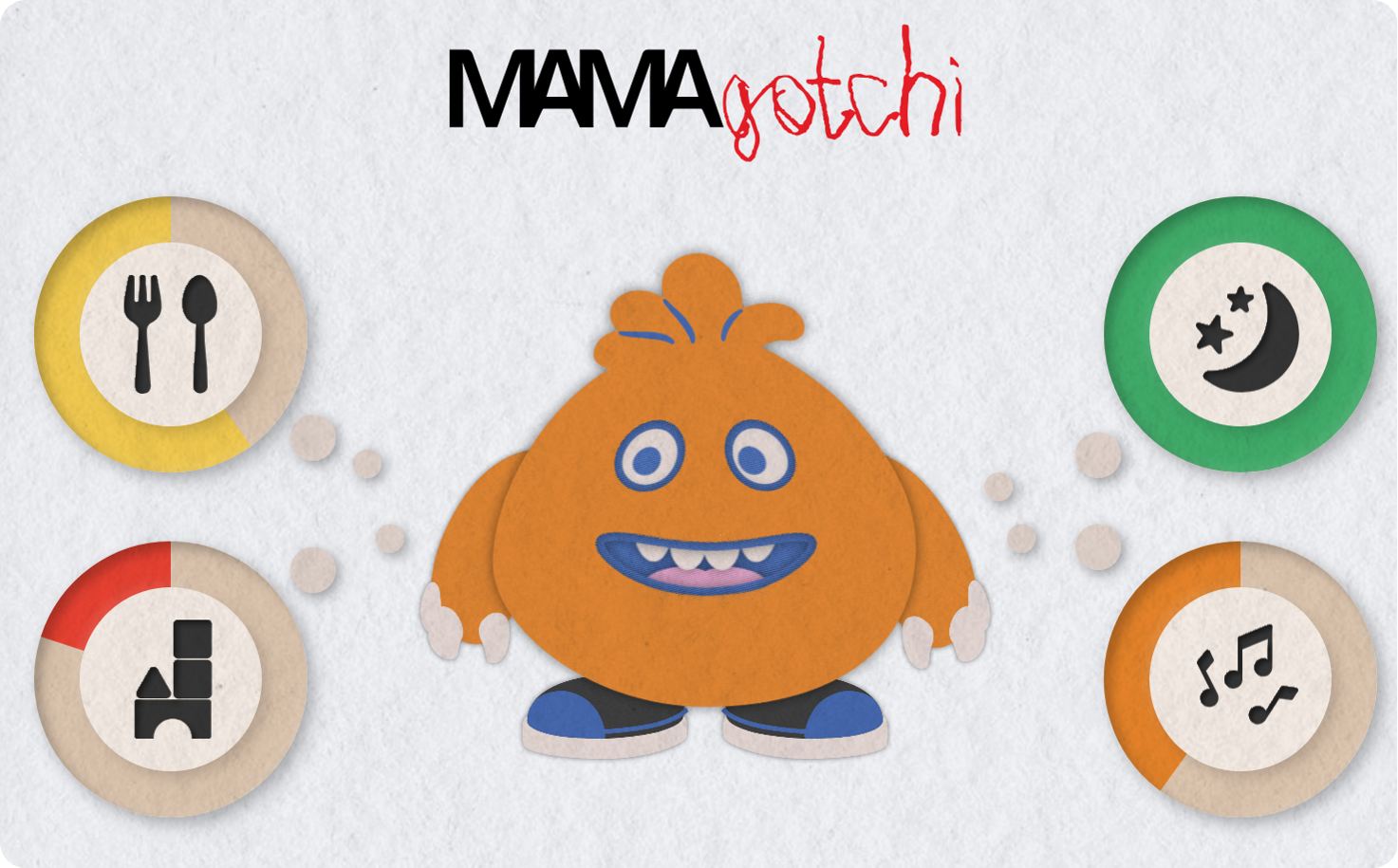
Over the course of the project, the visualization concept underwent several iterations, progressing from linear progress bars combined with a generic emoji-based facial expression to a custom-illustrated MAMAgotchi character whose facial expression reflects the aggregate wellbeing state, framed by the four categorical progress rings (see Figure 4). Our group implemented the corresponding front end, connecting the visual assets and layout to the live state produced by the business logic module so that the displayed representation updated correctly whenever the underlying system state changed. The state representation exposed by our business logic module had to be defined in a way that was both technically consistent and directly usable by the visualization design.
Limitations and Future Work
Several aspects of the current implementation remain open for further refinement. The autostart configuration currently has to be set up manually once on each new Raspberry Pi, which would benefit from further automation should the hardware need to be replaced, e.g. due to a defect. Beyond deployment, the system currently provides limited visual feedback, upon state changes and no dedicated visual indicator (e.g. desutarion) for blocked stations. Extending the central MAMAgotchi with haptic or acoustic feedback would be a natural next step.
Conclusion
The interface group’s contribution to MAMAgotchi was the “brain” of the system. A central state and data management layer connect distributed physical stations to a coherent virtual representation. On the communication side, an initially favored network-based approach (UDP, ESPythoNOW) was superseded by a simpler serial-based architecture, showing that implementation robustness, rather than architectural sophistication, was the decisive criterion for this project. On the logic side, a small set of decaying needs, combined with a threshold-based blocking mechanism, was sufficient to translate everyday tasks into a mood state that reflects the project’s underlying metaphor of ongoing care work. Finally, the technical implementation and integration of the visualization ensured that this infrastructure remained visible and legible to users, while the containerized, autostarting deployment made the system robust enough to be run without technical supervision, e.g. at exhibitions.
References
ChuckMash (2026): ESPythoNOW, Retrieved July 6, 2026, from https://github.com/ChuckMash/ESPythoNOW
Repositories
Disclosure Statement
This text was prepared with the assistance of the AI language model Sonnet-5 (Claude), which was used for drafting and linguistic revision. The authors defined the content requirements and remain responsible for the final version.